
Isa Key Facts
What the record shows
- Sound
- /i/
- Ætt
- Hagal's ætt, 3rd of 8
- Literal meaning
- Ice
- Rune poems
- Ice in all three: a slippery, gleaming floor (Old English), a broad bridge (Norwegian), roof of the wave (Icelandic)
- Other names
- Īs (Old English), Íss (Old Norse), iiz (Gothic letter name)
In modern rune reading
- Associated deity
- —
- Element
- Ice in some systems; no agreed element
- Yes or No?
- No
- Love
- A pause or cooling-off; frozen distance in a hard position
- Career & money
- Standstill: wait and consolidate; stalled plans in a hard position
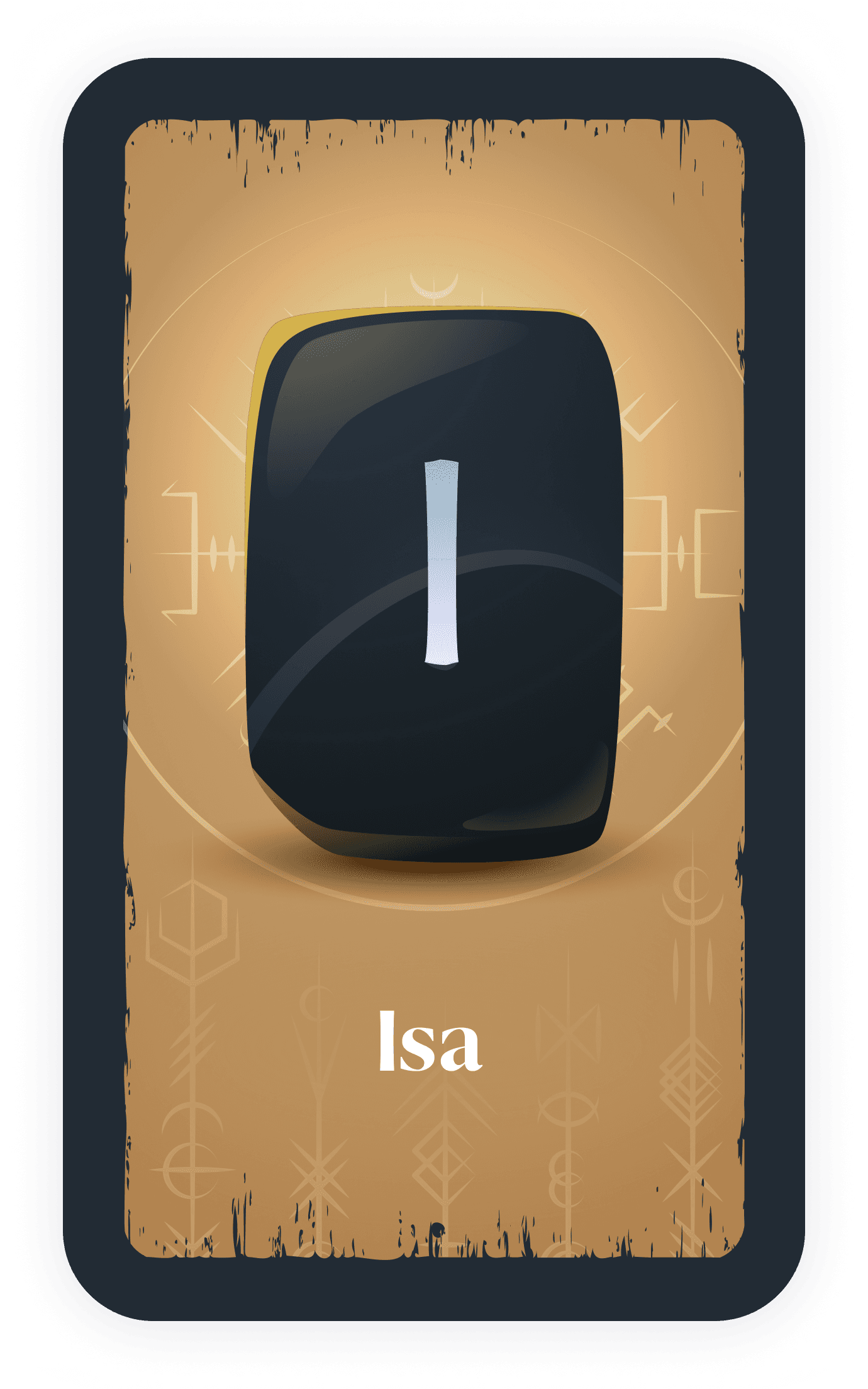
Isa is the eleventh rune of the Elder Futhark: a single vertical stroke, with a name that means ice. All three rune poems describe ice, and modern readers make it the rune of stillness — a process frozen mid-motion. This page keeps what the record supports apart from what modern rune reading adds, and explains why Isa cannot be reversed.
What does Isa mean?
Isa stood for the sound /i/. The name is reconstructed as Proto-Germanic *īsaz, "ice" — Old English īs, Old Norse íss and English ice all descend from it. The Gothic letter name was recorded as iiz. Sound, name and meaning are all secure, which makes Isa one of the easiest runes in the row to reconstruct.
The shape is the simplest possible: one straight stave that looks the same from either end. For people living through northern winters, ice was two things at once — the danger that froze rivers and killed travellers, and the hard surface that let you cross water you could not cross in summer. The rune poems keep both sides.
What do the rune poems say about Isa?
All three poems have a stanza for ice, and each looks at a different side of it.
- Old English (the Anglo-Saxon futhorc, 8th–9th century): ice is very cold and immeasurably slippery; it glistens clear as glass, most like gems — a floor made by frost, fair to look at.
- Old Norwegian (c. 13th century, Younger Futhark): ice we call the broad bridge; the blind man must be led.
- Old Icelandic (c. 15th century, Younger Futhark): ice is the bark of rivers, the roof of the wave and the destruction of doomed men, glossed with the Latin glacies, ice.
The poems are late and describe later rune rows. The Old English poem belongs to the Anglo-Saxon futhorc; the Norse poems to the 16-rune Younger Futhark. They are the best evidence for what the Elder Futhark names meant, not a manual for how anyone used Isa in a reading.
Read together, the stanzas are more double-edged than the modern keyword. Ice is beautiful, and it is a bridge — but it is also treacherous underfoot and deadly for those fated to fall through. The Norwegian line about the blind man needing a guide adds a warning worth keeping: stillness is not the same as safety.
Isa upright meaning
In modern rune reading Isa is a rune of standstill: a pause, a delay, a situation frozen until conditions change. Readers do not treat it only as frustration. Ice also preserves, so Isa is read as a time to stop, keep what you have intact, and see clearly before moving.
- Standstill — plans on hold, nothing moving for now.
- Stillness by choice — rest, patience, withdrawal, self-control.
- Clarity — ice as clear glass: seeing a situation without the noise.
Isa reversed: why there is no merkstave
Isa is a single straight line with no top and no bottom, so there is no reversed position to draw, and no rune set can show one. Readers who want to express Isa's harder side do it through context: Isa beside difficult runes, or in answer to a question about something that needs to move, is read as a freeze that will not break easily, isolation, or stubbornness.
Reversed readings are a modern convention, and Isa is the plainest proof. The rune poems give no inverted stanza for any rune, and a single stave cannot be upside down. Gebo, Hagalaz, Naudhiz and Jera share the problem in less obvious ways.
Isa in love and relationships
In a love reading Isa signals a cooling or a pause: space needed, feelings on hold, a relationship that is neither ending nor moving forward. It can also mean giving someone time. In a hard position readers see emotional distance, a stalemate, or one partner freezing the other out.
Isa in career and money
At work Isa means a standstill: a hiring freeze, a delayed decision, a project waiting on someone else. The modern advice is to consolidate rather than force movement. In a difficult spread readers look for stagnation, a blocked path, or a role you have outgrown but not yet left.
Is Isa a yes or no rune?
In yes-or-no rune reading Isa is a no — or more exactly a "not now, nothing will move yet". Because it cannot be reversed, orientation never turns it into a yes. This is purely modern divinatory practice; there is no historical evidence of runes being read this way.
What is attested and what is modern
| Layer | Isa | How solid |
|---|---|---|
| Sound | /i/ | Solid — read in surviving inscriptions |
| Name and literal meaning | *īsaz, ice | Strong — every source agrees |
| Ice as bridge, beauty and danger | In all three rune poems | Attested, but medieval |
| No reversed form | A single straight stave | A fact of the glyph |
| Stillness, standstill, yes or no | Modern divination | 20th-century practice |
Isa is the third rune of Hagal's ætt, after Naudhiz, need, and before Jera, the year turning toward harvest. Readers often pair it with Kenaz, fire set against ice, and with Laguz, water free to move. For the whole row, see Elder Futhark rune meanings.
What does the Isa rune mean?
Isa stood for the sound /i/, and its name is reconstructed as *īsaz, ice. All three rune poems describe ice, and modern rune readers use Isa for stillness, standstill and a situation frozen until conditions change.
Does Isa have a reversed meaning?
No. Isa is a single straight stave with no top or bottom, so it cannot be drawn reversed. Readers take any harder reading from the question or the surrounding runes — a freeze that will not break, or isolation.
Is Isa a negative rune?
It is a rune of delay rather than harm. The rune poems call ice both beautiful and dangerous, a bridge and a trap, and modern readers treat Isa as a time to pause, preserve what you have and see clearly.
Which rune looks like a straight line?
That is Isa, ᛁ, the ice rune and the Elder Futhark letter for /i/. Its shape is a single vertical stave, which is also why it has no reversed or merkstave position.