
Jera Key Facts
What the record shows
- Sound
- /j/ (y)
- Ætt
- Hagal's ætt, 4th of 8
- Literal meaning
- Year; a good season, harvest
- Rune poems
- Plenty in all three: God's gift of bright fruits (Old English), a boon to men (Norwegian, Icelandic)
- Other names
- Gēr (Old English), Ár (Old Norse), gaar (Gothic letter name)
In modern rune reading
- Associated deity
- Freyr — a modern link, not attested
- Element
- Earth in some systems; no agreed element
- Yes or No?
- Yes
- Love
- Patient growth and commitment over time; bad timing in a hard position
- Career & money
- Earlier work paying off; a delayed return in a hard position
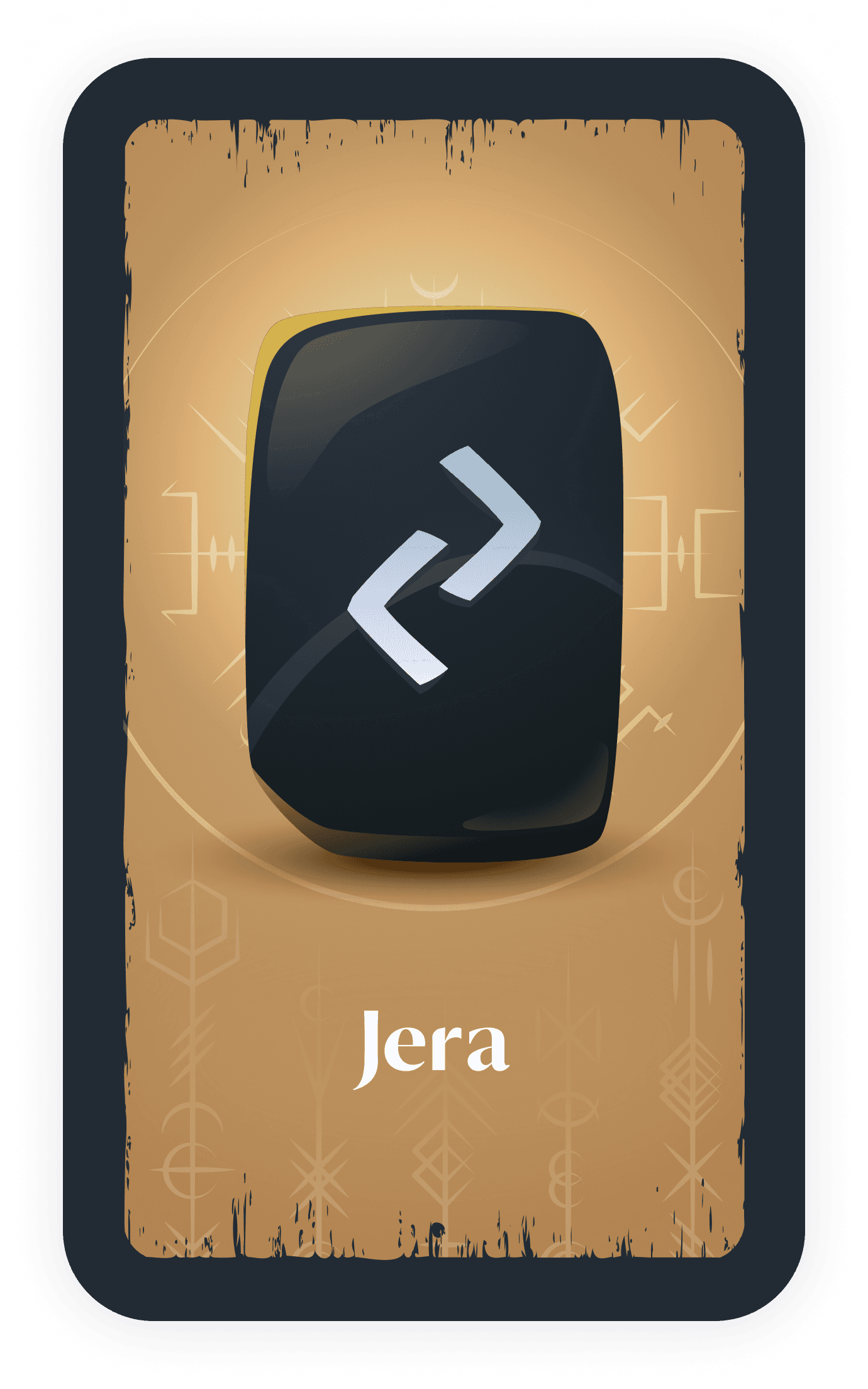
Jera is the twelfth rune of the Elder Futhark, the midpoint of the 24. Its name means year — in the sense of a good year, a harvest — and all three rune poems read it as plenty. Modern readers make it the rune of cycles and of reward that arrives in its own time. This page keeps the two layers apart and explains why Jera cannot be reversed.
What does Jera mean?
Jera stood for /j/, the y of English year. The name is reconstructed as Proto-Germanic *jēran, "year, good season" — the source of English year, German Jahr and Gothic jēr; the Gothic letter name was recorded as gaar, and the Old English rune name is gēr. In a farming world a year was measured by what it produced, and the word leaned naturally toward harvest.
In Scandinavia the word lost its first sound and became Old Norse ár. The rune's Younger Futhark descendant, ᛅ, kept that name and wrote an a-sound — a rune named for a y-word ended up standing for a vowel because the word itself had changed. The Elder Futhark shape, ᛃ, is two hooked strokes set around a centre, and it looks the same upside down.
What do the rune poems say about Jera?
All three poems give the rune a stanza, and all three are glad of it.
- Old English (the Anglo-Saxon futhorc, 8th–9th century): the good year is a joy to men when God, holy king of heaven, lets the earth bring forth bright fruits for rich and poor alike.
- Old Norwegian (c. 13th century, Younger Futhark): plenty is a boon to men; I say that Fróði was generous.
- Old Icelandic (c. 15th century, Younger Futhark): plenty is a boon to men, a good summer and thriving crops, glossed with the Latin annus, year. The oldest manuscript is damaged here, so the last lines are partly reconstructed.
The poems are late and describe later rune rows. The Old English poem belongs to the Anglo-Saxon futhorc; the Norse poems to the 16-rune Younger Futhark. They are the best evidence for what the Elder Futhark names meant, not a manual for how anyone used Jera in a reading.
Read together, this is the most cheerful stanza in its stretch of the poems. The Norwegian poet's Fróði is a legendary Danish king whose reign was remembered as a golden age of peace and plenty. The English poem adds the idea modern readers keep: the harvest comes when heaven allows it, and it comes to rich and poor alike.
Jera upright meaning
In modern rune reading Jera is a rune of cycles and results: work done earlier bearing fruit, a season turning, reward arriving on its own schedule. Readers stress timing — nobody harvests in spring — and treat Jera as encouragement to keep tending what is already planted.
- Harvest — the payoff of sustained effort.
- Cycles — seasons, rhythms, a year's worth of change completing.
- Patience — good things that arrive when they are ready, not when you want them.
Jera reversed: why there is no merkstave
Jera's two hooked strokes swap places when the rune is turned, so it looks the same upside down and cannot be drawn reversed. Most readers give it no merkstave meaning. When Jera falls in a difficult spread they read the cycle rather than the reward: bad timing, a harvest that is not ready yet, or the consequences of what was planted coming due.
Reversed readings are a modern convention, and symmetrical runes expose it. The rune poems give no inverted stanza for any rune, and several runes look identical upside down — Jera, Gebo, Isa, Ingwaz and Sowilo among them — so for them "reversed" is not defined.
Jera in love and relationships
In a love reading Jera is about relationships that grow with time: commitment deepening, a slow courtship paying off, a milestone after a long season together. It advises patience over pressure. In a hard position readers see bad timing, or a relationship reaping what was sown — for better or worse.
Jera in career and money
At work Jera points to results arriving: a promotion after years of effort, a project finally paying off, the right moment to collect. It favours long-term plans over quick wins. In a difficult spread readers look for a delayed return, or a cycle that has to finish before the next one can start.
Is Jera a yes or no rune?
In yes-or-no rune reading Jera is a yes — often with the note "in time" rather than "now". Because it has no reversed form, orientation does not flip the answer. This is purely modern divinatory practice; there is no historical evidence of runes being read this way.
What is attested and what is modern
| Layer | Jera | How solid |
|---|---|---|
| Sound | /j/ (y) | Solid — read in surviving inscriptions |
| Name and literal meaning | *jēran, year, harvest | Strong — reconstructed from the poems, Gothic and cognates |
| Plenty and a good harvest | In all three rune poems | Attested, but medieval |
| Freyr | Modern association | No historical source links him to the rune |
| Cycles, timing, yes or no | Modern divination | 20th-century practice |
Jera is the fourth rune of Hagal's ætt, after Isa — the thaw after the ice — and before Eihwaz, the yew. Readers often pair it with Fehu, wealth, and with Ingwaz, the seed before it shows. For the whole row, see Elder Futhark rune meanings.
What does the Jera rune mean?
Jera stood for the sound /j/ (y), and its name is reconstructed as *jēran, year — a good year, a harvest. All three rune poems read it as plenty, and modern readers use Jera for cycles, reward and patience.
Does Jera have a reversed meaning?
No. Jera's shape looks the same upside down, so it cannot be drawn reversed. When it lands in a difficult spread, readers take the harder shade from context — bad timing, or a harvest not yet ready.
Is Jera connected to Freyr?
Only in modern rune books. Freyr was a god of fertility and good harvests, which makes the link intuitive, but no rune poem or other historical source ties him to this rune. The Norwegian poem names the legendary king Fróði instead.
Why does Jera look different in the Younger Futhark?
Old Norse lost the y-sound at the start of the word, so the name became ár. The rune's Younger Futhark form, ᛅ, kept that name, wrote an a-sound and has a different shape from the Elder Futhark's ᛃ.