
Laguz Key Facts
What the record shows
- Sound
- /l/
- Ætt
- Tyr's ætt, 5th of 8
- Literal meaning
- Water, lake, sea; "leek" also proposed
- Rune poems
- Water in all three: the frightening sea (OE), a waterfall (Norw.), an eddying stream (Icel.)
- Other names
- Lagu (Old English), Lǫgr (Old Norse), laaz (Gothic letter name), Laukaz
In modern rune reading
- Associated deity
- —
- Element
- Water in modern systems, following the name
- Yes or No?
- Maybe
- Love
- Emotional depth and intuition; confusion or overwhelm when reversed
- Career & money
- Trusting instinct, adaptability; drifting or poor judgement when reversed
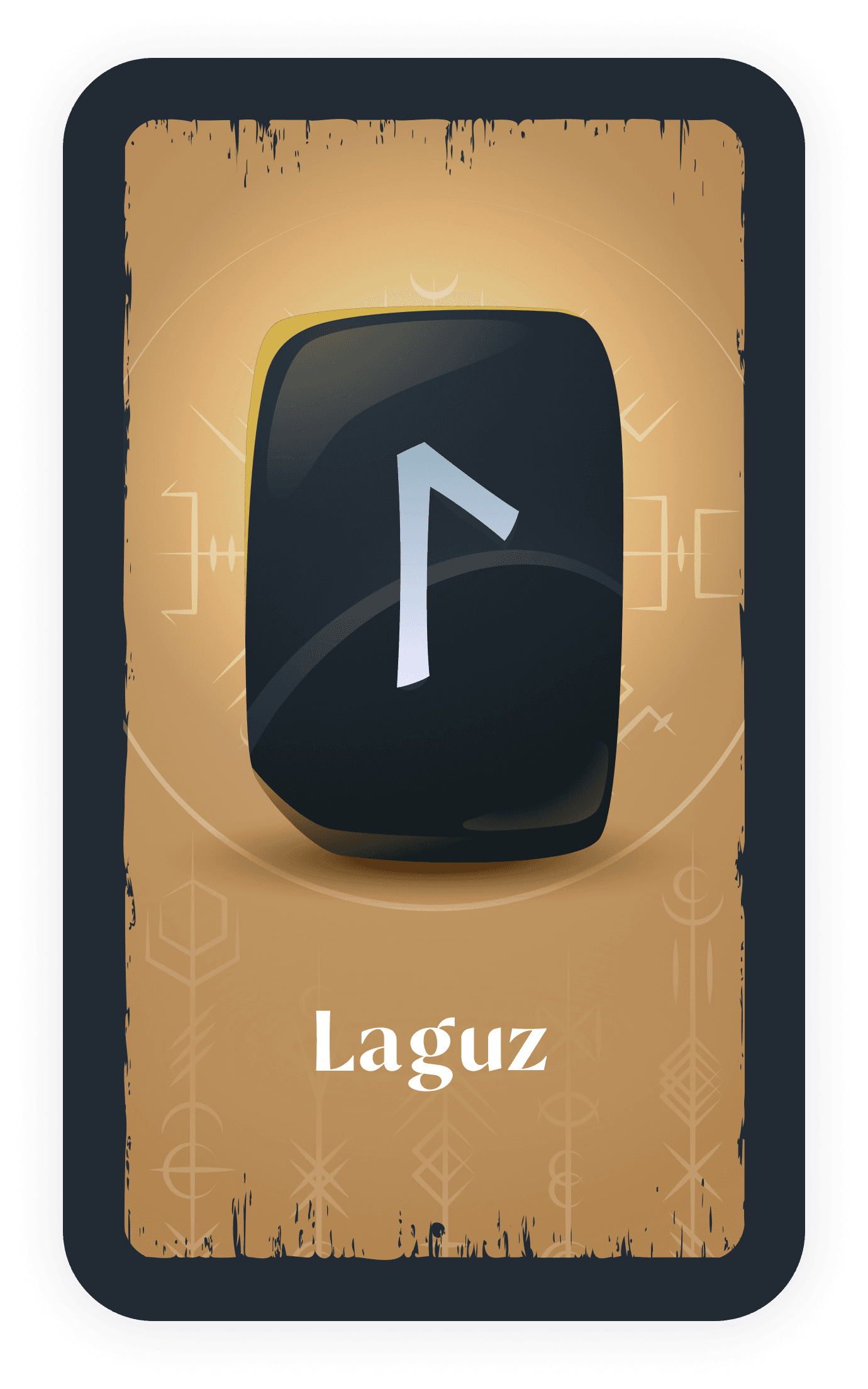
Laguz is the twenty-first rune of the Elder Futhark. Its name is usually given as water — lake, sea, the thing that moves beneath a boat — though a second reconstruction reads it as leek. This page keeps two layers apart: what the historical record supports, and what modern rune reading has built on top of it.
What does Laguz mean?
Laguz stood for the sound /l/. The standard reconstruction is Proto-Germanic *laguz, "water, lake, sea", supported by Old English lagu and Old Norse lǫgr, both meaning water or sea, and by the Gothic letter name laaz. That is a solid chain, and it is what most rune lists give.
The alternative is *laukaz, "leek". It comes not from the rune poems but from early inscriptions: the word laukaz recurs on Elder Futhark objects in contexts that look formulaic, the kind of word runologists take seriously as possibly ritual. Some scholars argue the l-rune could stand for it. Most lists give you water without mentioning there is an argument.
What do the rune poems say about Laguz?
All three poems have a stanza, and all three are about water — but water to fear or respect, not water to intuit.
- Old English (the Anglo-Saxon futhorc, 8th–9th century): the sea seems endless to people who must venture out on a rolling boat, when the waves terrify them and the sea-horse ignores its bridle.
- Old Norwegian (c. 13th century, Younger Futhark): water is what falls from the mountainside as a waterfall; the second line turns to ornaments of gold.
- Old Icelandic (c. 15th century, Younger Futhark): water is an eddying stream, a broad kettle — usually taken as a geyser — and the land of the fish, glossed with the Latin lacus, lake.
The poems are late and describe later rune rows. The Old English poem belongs to the Anglo-Saxon futhorc; the Norse poems to the 16-rune Younger Futhark. They are strong evidence for the water reading, but they cannot rule out the leek, which rests on older inscriptions.
Side by side, the stanzas treat water as force and danger: an open sea that frightens sailors, water crashing off a mountain, a boiling spring. The modern reading of Laguz as intuition and the unconscious is a long step from that — an extension of "what moves beneath the surface" rather than anything the poets say.
Laguz upright meaning
In modern rune reading an upright Laguz is the rune of intuition and flow: emotions, dreams, the unconscious, and the wisdom of moving with a current rather than against it. Readers treat it as a prompt to trust what you sense before you can explain it.
- Intuition — gut feeling, dreams, knowledge that arrives before reasons.
- Flow — adaptability; letting a situation take its course.
- Emotional depth — feelings that run deeper than they look on the surface.
Laguz reversed (merkstave) meaning
Drawn upside down, Laguz is read as the water turning dangerous — ironically, the side the poems actually describe. Readers see confusion, fear, emotional overwhelm, poor judgement, or drifting without direction. Some read it as intuition being ignored, or as wishful thinking dressed up as a gut feeling.
Reversed readings are a modern convention. The rune poems give one stanza per rune and no inverted counterpart; merkstave meanings come from 20th-century rune books. Many practitioners find them useful — just know which layer you are using.
Laguz in love and relationships
In a love reading Laguz is about emotional depth: a relationship with strong intuitive understanding, feelings running high, or a need to follow the heart rather than a plan. Reversed, readers look for emotional confusion, being swept away by a relationship, or fear keeping someone from opening up.
Laguz in career and money
Upright Laguz suggests trusting your instincts at work, adapting to a changing situation, or creative work that relies on feel. Reversed, it warns against decisions made in an emotional fog, drifting without a plan, or ignoring a warning you already sensed.
Is Laguz a yes or no rune?
In yes-or-no rune reading Laguz is usually a maybe: the answer depends on what you already sense, and readers advise trusting your intuition. Reversed, most readers take it as a no, or as a sign you are not seeing clearly. This is purely modern divinatory practice — there is no historical evidence of runes being read this way.
What is attested and what is modern
| Layer | Laguz | How solid |
|---|---|---|
| Sound | /l/ | Solid — read in surviving inscriptions |
| Name | *laguz, water; or *laukaz, leek | Water is standard; leek a serious alternative |
| Water as danger and force | In all three rune poems | Strong, but the poems are medieval |
| The word laukaz | Early Elder Futhark inscriptions | Attested word; link to the rune debated |
| Intuition, merkstave, yes or no | Modern divination | 20th-century practice |
Laguz is the fifth rune of Tyr's ætt, after Mannaz, the human being, and before Ingwaz, the seed. Readers often set it against Isa, water frozen still, and beside Perthro as another rune of what is hidden. For the leek debate and the other disputed names, see Elder Futhark rune meanings.
What does the Laguz rune mean?
Laguz most likely meant water — lake or sea — and stood for the sound /l/; a minority reconstruction reads it as leek. All three rune poems describe water. Modern rune readers use Laguz for intuition, emotion, flow and the unconscious.
What does Laguz mean reversed?
In modern practice a reversed Laguz is read as confusion, fear, emotional overwhelm or poor judgement. Reversed meanings are a 20th-century convention; the rune poems give one stanza per rune and no inverted reading.
Does Laguz mean water or leek?
Most scholars and rune lists give water, supported by Old English lagu, Old Norse lǫgr and all three rune poems. The leek reading, *laukaz, rests on that word appearing on early inscriptions. The question is not fully settled.
Is Laguz a yes or no rune?
In modern practice Laguz is usually a maybe that asks you to trust your intuition; reversed, it leans toward no. Yes-or-no reading is modern divination, with no historical evidence behind it.