
Ansuz Key Facts
What the record shows
- Sound
- /a/
- Ætt
- Freyr's ætt, 4th of 8
- Literal meaning
- A god, one of the Æsir
- Rune poems
- Mouth, source of speech (Old English); estuary (Norwegian); Odin (Icelandic)
- Other names
- Ōs (Old English), Áss / Óss (Old Norse), aza (Gothic letter name)
In modern rune reading
- Associated deity
- Odin, named in the Icelandic poem's kennings
- Element
- Air in some systems; no agreed element
- Yes or No?
- Yes
- Love
- Honest talk and good counsel; mixed signals or deceit when blocked
- Career & money
- Communication, teaching, advice; misinformation when blocked
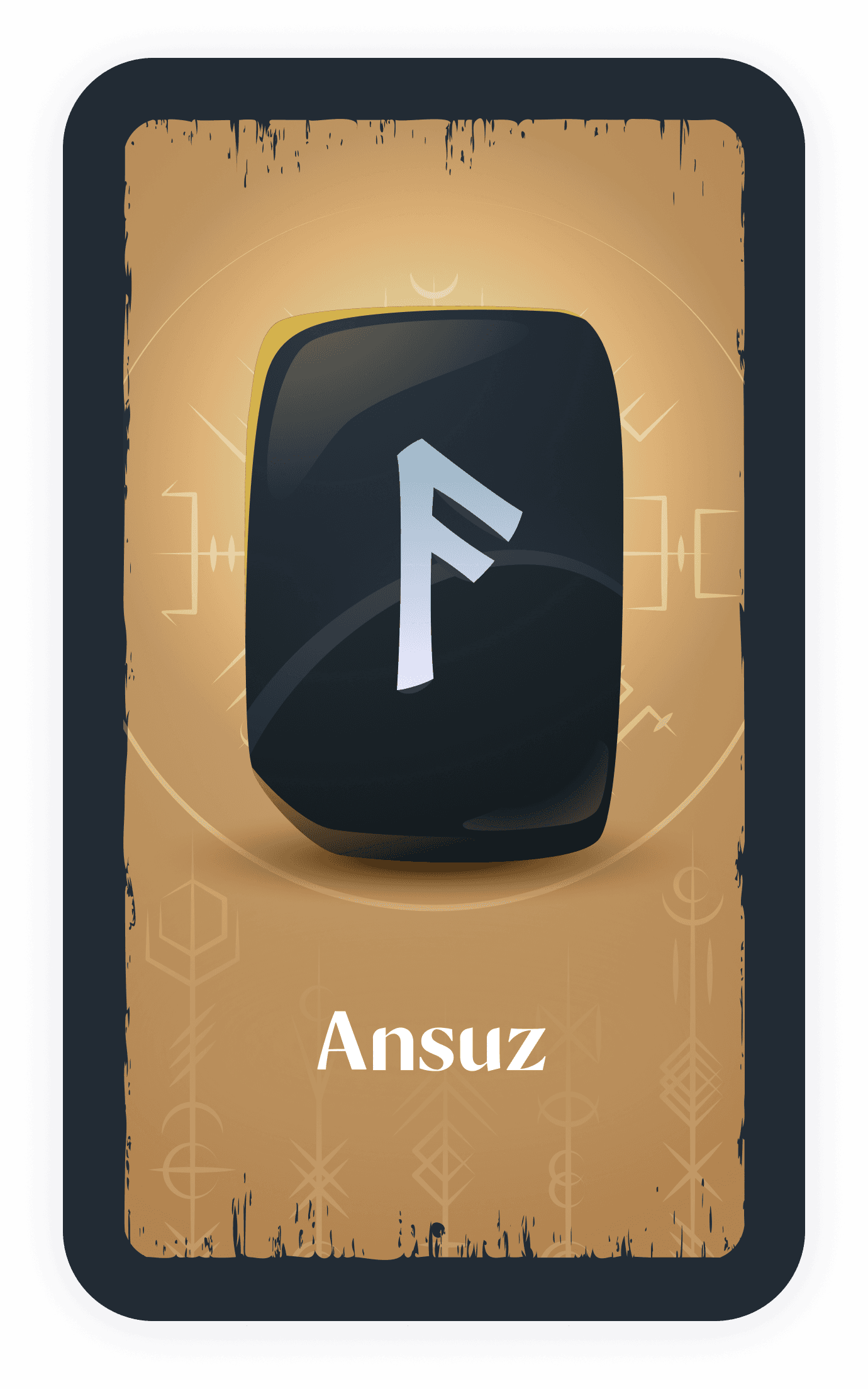
Ansuz is the fourth rune of the Elder Futhark, the a in "futhark". Its name is reconstructed as a god — one of the Æsir, the family of Odin and Thor — and modern readers make it the rune of speech, messages and inspiration. This page separates what the historical record supports from what modern rune reading has added.
What does Ansuz mean?
Ansuz stood for /a/. The name is reconstructed as Proto-Germanic *ansuz, "god" — the word behind Old Norse áss, plural æsir, the gods of Odin's family. The Gothic letter name, recorded as aza or ahsa, is ambiguous enough that a minority reading, *ahsam, "ear of wheat", has been proposed. The god reading is the standard one.
The name took unusual turns later. As Norse pronunciation shifted, the Younger Futhark's descendant of this rune, óss, came to write a nasal vowel, and the Norwegian poet heard its name as óss, "river mouth". In England the rune became ōs, and the stanza reads like a description of the Latin os, "mouth". One rune name reached the Middle Ages meaning god, estuary and mouth at once — which is exactly why modern readers link it to speech.
What do the rune poems say about Ansuz?
All three poems have a stanza for this rune, and each hears the name differently.
- Old English (the Anglo-Saxon futhorc, 8th–9th century): the ōs is the source of all language, a pillar of wisdom, a comfort to the wise and a blessing to every noble. It reads like a mouth, but the praise keeps the older sense of a god in view.
- Old Norwegian (c. 13th century, Younger Futhark): estuary is the way of most journeys, but the scabbard is the way of swords.
- Old Icelandic (c. 15th century, Younger Futhark): the god is aged Gautr, prince of Ásgard and lord of Valhalla — all names for Odin — glossed with the Latin Jupiter.
The poems are late and describe later rune rows. The Old English poem belongs to the Anglo-Saxon futhorc; the Norse poems to the 16-rune Younger Futhark. They are the best evidence for what the Elder Futhark names meant. The Old English poem is also the work of a Christian society, which may be why its god sounds like a mouth.
Read together, only the Icelandic poem keeps the god openly, and it names Odin. Modern readers join that Odin — god of poetry and, in Norse myth, of the runes — to the English poem's speech and wisdom, and the result is their Ansuz. The Norwegian estuary has dropped out of the modern meaning entirely.
Ansuz upright meaning
In modern rune reading an upright Ansuz is a rune of communication and insight: a message arriving, advice worth taking, the right words at the right moment, or a flash of understanding. Readers who follow the Odin connection add learning and inspiration.
- A message — news, a conversation, a letter or a sign worth noticing.
- Wise counsel — a teacher, a mentor, or advice you already half know.
- Inspiration — clarity, a creative idea, words finally coming.
Ansuz reversed (merkstave) meaning
Drawn upside down, Ansuz is read as communication going wrong: misunderstanding, gossip, being lied to or lying, advice that serves the adviser. Some readers treat it as a blocked voice — the thing you needed to say and did not.
Reversed readings are a modern convention. The rune poems give one stanza per rune and no inverted counterpart; merkstave meanings come from 20th-century rune books. Many practitioners find them useful — just know which layer you are using.
Ansuz in love and relationships
In a love reading Ansuz is about talking. Upright it points to an honest conversation, a declaration, or a partner who truly listens. Reversed, readers look for mixed signals, words that do not match actions, or manipulation dressed up as communication.
Ansuz in career and money
At work Ansuz favours anything that runs on words: teaching, writing, presenting, negotiating, advising. Upright it suggests a useful meeting or the piece of advice that unlocks a problem. Reversed it warns of misinformation, a contract read too quickly, or a message that failed to land.
Is Ansuz a yes or no rune?
In yes-or-no rune reading, an upright Ansuz is usually a yes, often with the note to listen for more information. Reversed, most readers take it as a no, or a sign that the question rests on a misunderstanding. This is purely modern divinatory practice; there is no historical evidence of runes being read this way.
What is attested and what is modern
| Layer | Ansuz | How solid |
|---|---|---|
| Sound | /a/ | Solid — read in surviving inscriptions |
| Name and literal meaning | *ansuz, a god of the Æsir | Strong — reconstructed from the poems and cognates |
| Odin | Named in the Icelandic poem's kennings | Attested, but in a poem of c. 15th century |
| Speech and wisdom | Old English "source of all language" | Medieval reading, extended by modern books |
| Upright, merkstave, yes or no | Modern divination | 20th-century practice |
Ansuz is the fourth rune of Freyr's ætt, between Thurisaz, the giant, and Raidho, the ride. It is named for a god in general; Tiwaz and Ingwaz are named for particular ones. Readers often pair it with Mannaz, humankind — the speaker beside the source of speech. For the whole row, see Elder Futhark rune meanings.
What does the Ansuz rune mean?
Ansuz stood for the sound /a/, and its name is reconstructed as *ansuz, a god — one of the Æsir. Modern rune readers use it for communication, messages, wisdom and inspiration, following the Old English poem's "source of all language".
What does Ansuz mean reversed?
In modern practice a reversed (merkstave) Ansuz is read as miscommunication, deceit, manipulation or bad advice. Reversed meanings are a 20th-century convention; the medieval rune poems give one stanza per rune and no inverted reading.
Is Ansuz Odin's rune?
The Icelandic rune poem describes the god of this rune with names of Odin: aged Gautr, prince of Ásgard, lord of Valhalla. That poem dates from around the 15th century, so the link is medieval — not proof of how earlier rune users saw it.
Why does the Old English poem call Ansuz a mouth?
The Old English name ōs also meant god, but the stanza describes a source of language and wisdom, which reads like Latin os, mouth. The long-standing explanation is a Christian poet steering away from a heathen god while keeping the old sense in view.