
Dagaz Key Facts
What the record shows
- Sound
- /d/
- Ætt
- Tyr's ætt, 7th of 8
- Literal meaning
- Day
- Rune poems
- Old English only: day, the Lord's messenger, a hope to rich and poor; no Norse stanza
- Other names
- Dæg (Old English), daaz (Gothic letter name)
In modern rune reading
- Associated deity
- —
- Element
- —
- Yes or No?
- Yes
- Love
- A turning point, clarity, a new phase together; limbo in a hard spread
- Career & money
- Breakthrough on a stuck project, a career change
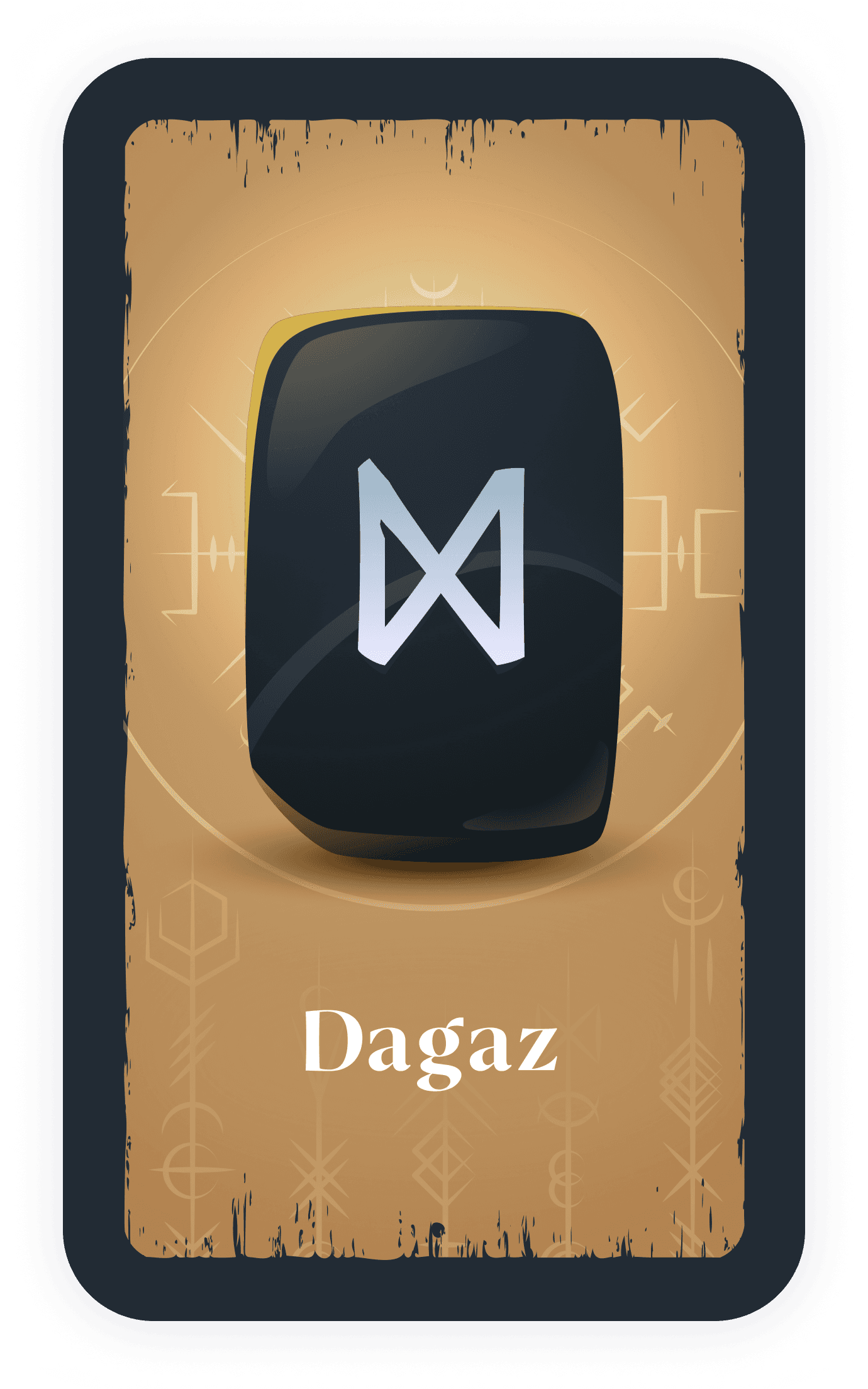
Dagaz is the twenty-third rune of the Elder Futhark, and its name meant day. On the earliest complete rune row it is second to last; on another it is the very last. This page keeps two layers apart: what the historical record supports, and what modern rune reading has built on top of it.
What does Dagaz mean?
Dagaz stood for the sound /d/, and possibly the softer /ð/ in some positions. Its name is reconstructed from Proto-Germanic *dagaz, "day", the ancestor of English day, German Tag and Old Norse dagr. The Old English rune name is dæg and the Gothic letter name daaz. The name itself is secure; the rune is simply less documented than most, because it did not survive into the Younger Futhark.
The shape is two triangles meeting at a point, like an hourglass on its side; one theory derives it from a letter of the ancient North Italic alphabets. Its place in the row wobbles: the Kylver Stone ends with Dagaz then Othala, while the Vadstena bracteate reverses the pair.
What do the rune poems say about Dagaz?
Only the Old English poem has a stanza for this rune, and it is one of the warmest in the poem.
- Old English (the Anglo-Saxon futhorc, 8th–9th century): day is the Lord's messenger, dear to men, the glorious light of the Creator, a hope and joy to rich and poor alike and of use to all.
- Old Norwegian (c. 13th century, Younger Futhark): no stanza. The Younger Futhark dropped Dagaz and wrote /d/ with the t-rune.
- Old Icelandic (c. 15th century, Younger Futhark): no stanza, for the same reason.
The poems are late and describe later rune rows. The Old English poem belongs to the Anglo-Saxon futhorc; the Norse poems to the 16-rune Younger Futhark. The Old English stanza is Christian through and through — day as the Creator's light — and its note of hope comes from that poet, not from the Elder Futhark.
The stanza's themes are light, hope and fairness: day comes to rich and poor alike. Modern readers push that toward dawn and breakthrough — the moment darkness turns to light — which is a natural reading of the word, though the poem itself speaks of ordinary daylight rather than transformation.
Dagaz upright meaning
In modern rune reading Dagaz is the rune of breakthrough: dawn after a long night, the moment a situation changes state, clarity arriving all at once. Many readers treat it as one of the most hopeful runes to draw, and some read its shape as a balance of opposites, night and day meeting.
- Breakthrough — a problem solved, a turning point, the end of a waiting period.
- Clarity — seeing a situation in full daylight; an insight that changes the picture.
- Transformation — a new phase beginning, often just after a hard one ends.
Dagaz reversed: why there is no merkstave
Dagaz looks the same upside down, so it cannot be drawn reversed, and rune books generally give it no merkstave meaning. Readers who want a shadow side read it through the runes around it: beside Isa or Naudhiz, the dawn can read as a breakthrough delayed, or as change arriving before you are ready for it.
Reversed readings are a modern convention anyway. The rune poems give one stanza per rune and no inverted counterpart, and symmetrical runes such as Dagaz, Ingwaz, Gebo and Isa show the limit of the idea: for them "reversed" is not even defined. More in how to read runes for beginners.
Dagaz in love and relationships
In a love reading Dagaz points to a turning point: a relationship moving into a new phase, a misunderstanding cleared up, or the moment someone sees clearly what they want. In a hard spread readers see limbo instead — waiting for a change that has not come, or a sudden shift that unsettles both partners.
Dagaz in career and money
Dagaz is a strong rune for work: a breakthrough on a stuck project, a promotion or career change, or an idea that suddenly makes everything click. In a difficult spread it warns of change for its own sake, or of burning out while chasing the next big shift.
Is Dagaz a yes or no rune?
In yes-or-no rune reading Dagaz is a yes, often read as "yes, and sooner than you think"; since it cannot be reversed, it stays a yes. This is purely modern divinatory practice — there is no historical evidence of runes being read this way.
What is attested and what is modern
| Layer | Dagaz | How solid |
|---|---|---|
| Sound | /d/ (possibly also /ð/) | Solid — read in surviving inscriptions |
| Name and literal meaning | *dagaz, day | Strong — cognates, Gothic daaz, Old English dæg |
| Day as the Creator's light and hope | Old English poem only | Attested, but medieval and Christian |
| Place in the row | 23rd on Kylver, last on Vadstena | Solid, but the two rows disagree |
| Breakthrough, yes or no | Modern divination | 20th-century practice |
Dagaz is the seventh rune of Tyr's ætt, after Ingwaz, the seed, and before Othala, the inherited estate. Readers often pair it with Sowilo, the sun, and set it against Hagalaz, change that arrives as damage rather than dawn. For the whole alphabet, see Elder Futhark rune meanings.
What does the Dagaz rune mean?
Dagaz literally meant day and stood for the sound /d/. The Old English rune poem calls day the Creator's glorious light, a hope to rich and poor. Modern rune readers use Dagaz for breakthrough, dawn, clarity and transformation.
Does Dagaz have a reversed meaning?
No. Dagaz looks the same upside down, so it cannot be drawn reversed, and most rune books give it no merkstave reading. Some readers take a darker tone from neighbouring runes; reversed meanings are modern in any case.
Is Dagaz the last rune of the Elder Futhark?
It depends on the source. The Kylver Stone, about 400 CE, ends with Dagaz then Othala, and most modern lists follow that order. The Vadstena bracteate, about a century later, reverses the pair, so Dagaz comes last there.
Is Dagaz a yes or no rune?
In modern practice Dagaz is a clear yes, often read as a breakthrough coming soon, and since it cannot be reversed it stays a yes. Yes-or-no reading is modern divination with no historical evidence behind it.