
Binah Key Facts
In Jewish Kabbalah
- Number
- 3 of 10
- Hebrew
- בינה, pronounced bee-NAH
- Meaning
- Understanding
- Pillar
- Pillar of Severity, at its head
- Triad
- Supernal triad, with Keter and Chokhmah
- Divine name
- YHVH Elohim (יהוה אלהים)
- Partzuf
- Imma, the Mother (Lurianic)
- Other spellings
- Imma, the Supernal Mother
In Hermetic Qabalah (Golden Dawn)
- Archangel
- Tzaphkiel
- Planet / sphere
- Saturn (Shabbathai)
- Colour (Queen scale)
- Black
- Virtue
- Silence
- Vice
- Avarice
- Tarot
- The four Threes
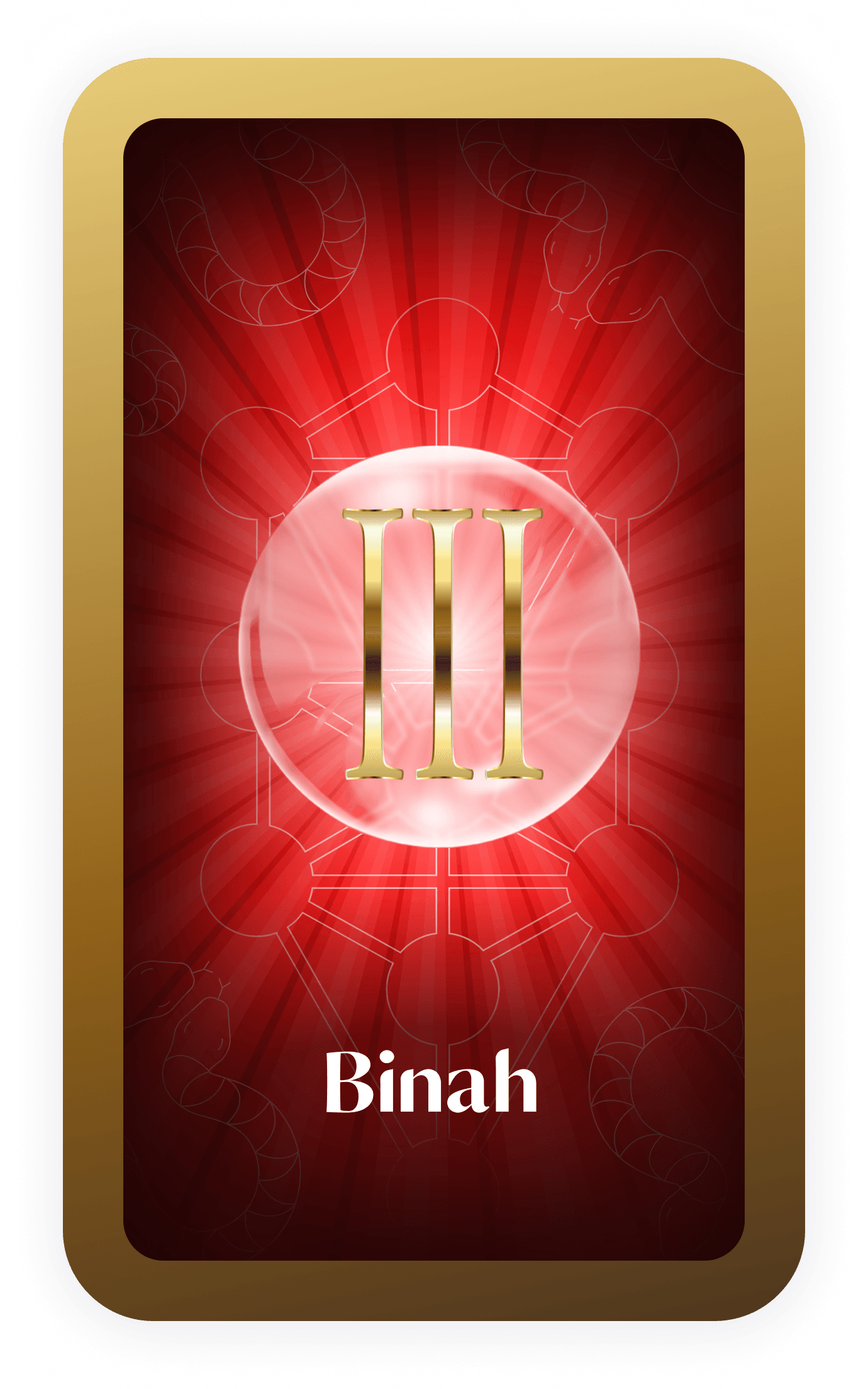
Binah is the third of the ten sephirot and the head of the Tree's left-hand pillar: understanding, the power that takes a flash of wisdom and gives it parts, shape and consequence. This page keeps two traditions apart — Jewish Kabbalah, where the sephirot come from, and the Hermetic Qabalah of the 19th century, which added angels, planets and tarot cards.
What does Binah mean?
Binah (בינה) comes from the same root as bein, "between": to understand, in this sense, is to tell one thing from another. The Talmud's phrase for it is mevin davar mitokh davar, understanding one matter out of another. Where Chokhmah sees a point, Binah draws out what follows from it.
Binah is also the sephirah of fifty. The Talmud (Rosh Hashanah 21b) speaks of fifty gates of understanding, all but one given to Moses, and Mishnah Avot 5:21 names forty as the age of binah — one root of the custom, as Kabbalah for beginners explains, of waiting until forty to study Kabbalah. Kabbalists picture Binah as a mother: the womb in which what Chokhmah seeds takes form.
Binah on the Tree of Life
On the diagram Binah heads the Pillar of Severity, the column of limit and form that runs down through Gevurah and Hod. With Keter and Chokhmah it closes the supernal triad. Below the triad many diagrams mark Da'at, knowledge — drawn, but never counted as an eleventh sephirah.
Four paths touch Binah on the familiar Western diagram: from Keter, across from Chokhmah, and down to Tiferet and Gevurah. Sefer Yetzirah ties the 22 paths to the 22 Hebrew letters, but it never says which letter joins which pair of sephirot; that wiring is a much later construction, and versions of it disagree.
Binah in Jewish Kabbalah
- Divine name. Binah is paired with the four-letter name written with the vowels of Elohim. Rabbinic tradition reads YHVH as God's attribute of mercy and Elohim as the attribute of judgement, so the name joins both at the head of the pillar of judgement. Hermetic tables write it YHVH Elohim.
- Partzuf. In the Lurianic system of the 16th century Binah is Imma, the Supernal Mother, paired with Abba, Chokhmah. From their union the six sephirot from Chesed to Yesod are born as a single face, Ze'ir Anpin.
- Return. In Moses Cordovero's Tomer Devorah (16th century), which teaches each sephirah as a trait to imitate, the chapter on Binah is about teshuvah — return, or repentance — which the book presents as able to repair every flaw.
The number fifty links Binah to the calendar. Sefirat ha-Omer counts forty-nine days through the seven lower sephirot, from Passover to Shavuot; many teachers read Shavuot, the fiftieth day, as the gate that the forty-nine lead to. Binah itself, like Keter and Chokhmah, is not one of the counted weeks.
Everything in the second half of the panel is Hermetic, not Jewish. Archangels, planets, colour scales, virtues and tarot cards on the sephirot come from Western occultism — Renaissance occult philosophy, then Éliphas Lévi in the 1850s and the Golden Dawn after 1888. They are a consistent system — and a later overlay on a medieval Jewish structure.
Binah in Hermetic Qabalah
The Golden Dawn, founded in 1888, kept the name Binah and filed it into its correspondences. Its archangel is Tzaphkiel; its sphere is Saturn, Shabbathai, the slowest of the classical planets; its Queen-scale colour is black. Dion Fortune's The Mystical Qabalah (1935) gives the virtue silence and the vice avarice, and adds titles of her own tradition — Marah, the Great Sea, and the dark and bright Mother.
In tarot the four Threes sit on Binah: the Three of Wands, Three of Cups, Three of Swords and Three of Pentacles. The Golden Dawn's tarot manuscript, Book T, titles them Established Strength, Abundance, Sorrow and Material Works — force given form, for better and worse. The paths from Binah carry The Magician (Beth), The Empress (Daleth), The Lovers (Zayin) and The Chariot (Cheth).
Binah in meditation and practice
In Jewish practice Binah is less a subject of visualisation than a discipline of study: the patient working-out of a text, one inference drawn from another. Chabad hitbonenut names this stage explicitly — the long unfolding of a concept in breadth and depth after the first insight has arrived.
In the Golden Dawn grade system Binah is Magister Templi, 8=3, the first grade of the "Third Order" reserved for the Secret Chiefs. Aleister Crowley later made the Master of the Temple a central ordeal of his own order, the A∴A∴, and Hermetic writers since treat Binah as the far side of the "Abyss".
What is Jewish and what is Hermetic
| Binah | Where it comes from | When |
|---|---|---|
| Name, "understanding", head of the Pillar of Severity | Jewish Kabbalah, Bahir and Zohar | 12th–13th century |
| Fifty gates of understanding; binah at forty | Talmud and Mishnah | Late antiquity |
| Imma, the Supernal Mother | Lurianic Kabbalah | 16th century |
| Tzaphkiel, Saturn, black; silence and avarice | Golden Dawn; Dion Fortune | 1880s–1930s |
| The four Threes; Magician, Empress, Lovers, Chariot on its paths | Lévi, then the Golden Dawn | 1850s onward |
Binah follows Chokhmah and completes the supernal triad; below Da'at the Tree continues with Chesed, the first of the seven lower sephirot. See all ten sephirot on the Tree, or read the Kabbalah Tree of Life explained for how the pillars and paths work together.
What does Binah mean?
Binah (בינה) is Hebrew for "understanding". It is the third sephirah on the Tree of Life and heads the Pillar of Severity: the power that develops Chokhmah's flash of insight into distinction, structure and form.
Why is Binah called the Mother?
In Lurianic Kabbalah Binah is the partzuf Imma, the Supernal Mother, paired with Abba, Chokhmah. The six sephirot from Chesed to Yesod are born from their union. Hermetic writers such as Dion Fortune later widened the image to the Great Mother.
Which tarot cards belong to Binah?
In Hermetic Qabalah the four Threes sit on Binah, and its paths carry the Magician, the Empress, the Lovers and the Chariot. These are Golden Dawn attributions from the 19th century, not part of Jewish Kabbalah.
What is the planet of Binah?
Saturn, in Hermetic Qabalah, along with the archangel Tzaphkiel and the colour black. The planetary spheres on the sephirot are a Hermetic table; in Sefer Yetzirah the seven planets belong to the seven double letters, not to the sephirot.